
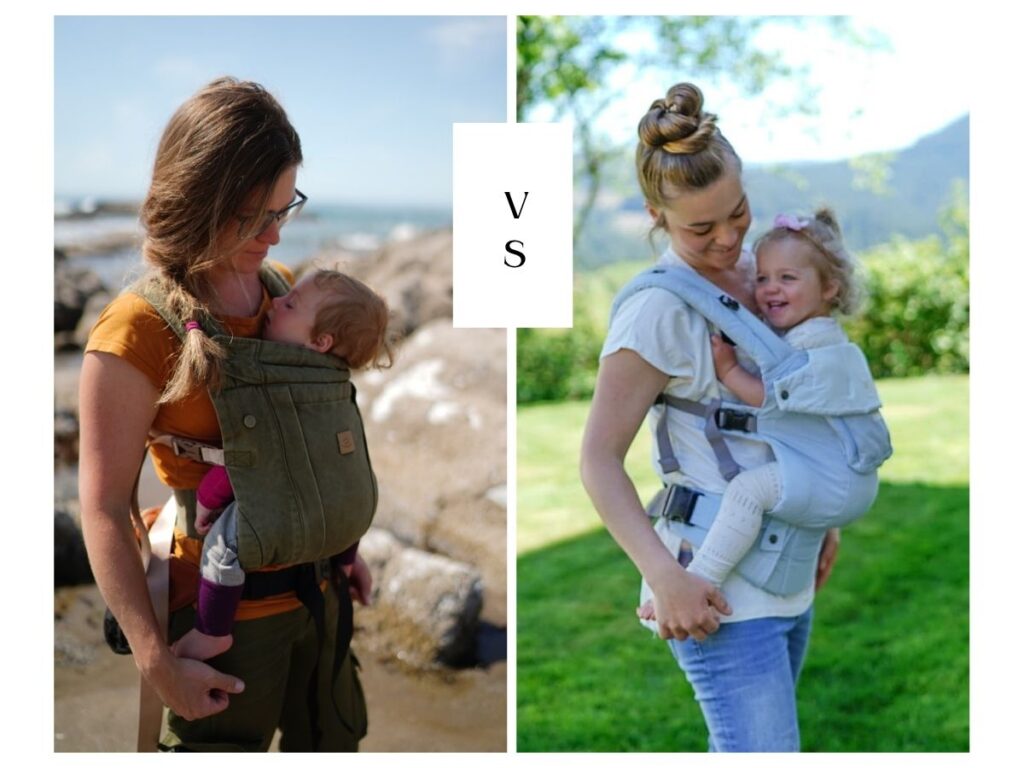
Apron vs Waterfall Baby Carriers: What’s the Difference?
If you’ve started comparing buckle baby carriers, you may have come across the terms apron style and waterfall style and wondered what they actually mean.
The difference is fairly simple: apron and waterfall describe how the body panel of a buckle carrier connects to and sits in relation to the waistband. But that seemingly small difference can change how a carrier sits on your body, where you feel your baby’s weight, and how much room the carrier takes up on your torso.
There’s also a third style, called a harness-style carrier, which works a little differently from both.
As a certified babywearing educator and a mom of four, I’ve used a lot of buckle carriers across all three styles. And while I definitely have my own preferences, there isn’t one construction that is universally better.
In fact, if you’ve tried a popular buckle carrier and hated how it felt, that doesn’t necessarily mean buckle carriers aren’t for you. You may simply prefer a different style of buckle carrier.
In this post, I’ll break down apron vs waterfall baby carriers, explain where harness carriers fit in, and share some of my favorite carriers in each category.
Apron vs Waterfall Baby Carriers
The easiest way to understand the difference is to look at where the carrier panel goes when you put the waistband on.
With an apron-style carrier, you put the waistband on almost like you would tie an apron. The body panel initially hangs down from the waistband before you bring it up between you and your baby.
With a waterfall-style carrier, the body panel starts above the waistband and comes up and over it, almost like water flowing over the edge of a waterfall.
That changes where the panel begins in relation to the waistband and can change how the carrier feels on your body.
Generally, apron-style carriers tend to feel a little more minimal around the waist and can work especially well for people with less torso space. Waterfall carriers often have more structure through the waistband and can provide a very supportive feeling, particularly as babies get heavier.
But those are tendencies, not rules.
The amount of padding, waistband shape, shoulder straps, panel construction, adjustability, and your own body all matter too.
What Is an Apron-Style Baby Carrier?
An apron-style buckle carrier gets its name from the way you put the waistband on.
Before putting your baby into the carrier, the body panel hangs down in front of you, similar to an apron. Once the waistband is secured, you bring the panel up between your baby’s legs and over their back.
Because of the way the panel connects to the waistband, apron-style carriers can be incredibly streamlined.
They often work well for caregivers who:
- Have a shorter or petite torso
- Don’t like bulky waistbands
- Want something relatively compact for travel or everyday use
- Prefer a simpler, less structured feeling carrier
One thing I really like about apron-style carriers is how much usable torso space they can give you.
If you’re petite or have a short distance between your ribs and hips, a large structured waistband can sometimes feel like it takes up your entire torso. An apron construction can reduce some of that bulk.
That does not mean every petite caregiver will prefer an apron carrier, though. Carrier fit is much more individual than that.
My Favorite Apron-Style Carriers
Keep Closer
Of the apron-style carriers I’ve used, Keep Closer is currently one of my favorites.
I particularly like it for petite caregivers because it gives me the streamlined feeling I tend to enjoy from an apron carrier without feeling like I’m giving up the adjustability I want from a buckle carrier.
Hope & Plum Lark
The Hope & Plum Lark is another apron-style carrier I really like, particularly when caregiver sizing is a concern.
Hope & Plum has put a lot of thought into making their carriers work across a wide range of caregiver bodies, and the Lark is one of my favorite buckle carrier recommendations for plus-size caregivers.
Best for: Caregivers wanting an apron-style carrier with inclusive sizing.
You can also read my Hope & Plum page for a look at all the carriers that Hope & Plum offers.
Happy Baby Original
The Happy Baby Original is probably one of the better-known examples of an apron-style buckle carrier.
It’s relatively simple and compact, which is part of why so many families like it for everyday babywearing and travel.
Best for: Someone wanting a simple, lightweight apron-style carrier.
You can also read my full Happy Baby original carrier review.
Sakura Bloom Scout
The Sakura Bloom Scout is another good example of apron-style construction, although its closure system makes it feel quite different from a traditional buckle carrier.
I like including it here because it also demonstrates why “apron style” only tells you one thing about a carrier. Two apron carriers can still feel completely different depending on their straps, closures, fabric, padding, and overall construction.
You can also read my full review of the Sakura Bloom scout.
What Is a Waterfall-Style Baby Carrier?
With a waterfall carrier, the body panel attaches at or near the top of the waistband and comes up over it.
Instead of the panel beginning below the waistband and folding upward like an apron carrier, the fabric appears to “fall” over the waistband, which is where the waterfall name comes from.
Many waterfall carriers pair this construction with a more structured or padded waistband.
That combination can create a very supportive feeling around the hips and lower torso, particularly as your baby gets heavier.
Waterfall carriers may be a good fit if you:
- Like a substantial, supportive waistband
- Are carrying an older or heavier baby or toddler
- Prefer feeling your baby’s weight spread across a larger waistband
- Have enough torso space for a larger waistband
- Simply find this construction more comfortable on your body
Again, waterfall does not automatically mean bulky or heavily padded.
There are very soft, flexible waterfall carriers and much more structured ones. That’s why I wouldn’t choose a carrier based on “apron vs waterfall” alone.
My Favorite Waterfall Carriers
LennyLamb Upgrade Pro
If I had to choose one waterfall-style carrier overall, it would be the LennyLamb Upgrade Pro.
It’s also one of my favorite buckle carriers in general.
I like how adjustable it is, and it works well across a surprisingly large portion of the babywearing years. It’s one of the carriers I reach for when I want the support of a waterfall-style carrier without the entire carrier feeling excessively stiff or structured.
It’s also currently one of my favorite options for newborn babywearing.
Best for: Someone who wants a highly adjustable waterfall carrier that can work from the early months into toddlerhood.
I compare more of my favorite carriers in my best baby carriers post.
Tula
Tula carriers are another really recognizable example of the more structured feeling you can get from a waterfall-style carrier.
I especially like the firmer waistband for caregivers who prefer feeling substantial support around their waist.
My husband, for example, tends to prefer this type of structured waistband more than I do.
That’s a perfect example of why I don’t think there is one “best” construction. Two caregivers carrying the exact same child can have completely different preferences.
Sestrice
Sestrice is another waterfall-style carrier worth considering. It has a softer waterfall waistband that’s incredible on the pelvic floor.
It gives you another example of how much variation exists within this category. Choosing waterfall construction doesn’t mean you’re choosing one particular fit or level of structure.
Love Radius
I also really like Love Radius, particularly when back carrying becomes part of the conversation.
Some Love Radius carriers have features I find genuinely useful for back carrying, including long PFAs that can make adjustments easier and, depending on the model, features designed to provide additional support when a child falls asleep. It’s one of my favorite options in a buckle carrier for earlier back carrying.
What About Harness-Style Baby Carriers?
Apron and waterfall aren’t the only constructions you’ll see.
The third major style is what is generally called a harness-style carrier.
Instead of putting the waistband on and then bringing the carrier panel up around your baby, a harness carrier is designed so that part of the carrier goes onto the caregiver first. You then bring baby into the carrier and secure the remaining portion around them.
BabyBjörn makes some of the most recognizable examples of this style.
For some caregivers, that process feels incredibly intuitive because the carrier is already attached to their body before they position their baby.
For others, it can feel like more carrier than they want to deal with.
This is another reason I don’t think there is one buckle-carrier construction everyone should use.
Best for: Caregivers who like having the carrier secured to their own body before bringing baby into it.
Apron vs Waterfall vs Harness at a Glance
Style | How It Works | Often Appeals To |
Apron | Panel hangs below the waistband before being brought up around baby | Caregivers wanting a streamlined carrier, less bulk, or more torso space |
Waterfall | Panel comes up from and over the waistband | Caregivers who like a more substantial or supportive waistband |
Harness | Part of the carrier is secured to the caregiver before baby is placed inside | Caregivers who like getting the carrier onto themselves before positioning baby |
Is Apron or Waterfall Better for Newborns?
Neither construction is automatically safer or better for a newborn simply because it is apron or waterfall style.
What matters much more is whether the specific carrier is designed to fit your baby’s current size, whether you can adjust it appropriately, and whether you can maintain a safe carrying position.
For a newborn, I want to see a carrier that can create an appropriately narrow seat, support baby’s body without forcing their legs too wide, and allow the caregiver to maintain a clear, visible airway.
Of the carriers in this article, my personal favorite for newborns is the LennyLamb Upgrade Pro.
But there are plenty of excellent newborn carriers across different construction styles.
I go much deeper into this in Best Newborn Baby Carriers, including options beyond buckle carriers.
Is Apron or Waterfall Better for Toddlers?
This is where personal preference becomes even more noticeable.
As your child gets heavier, you may find yourself wanting more structure around your waist. Some caregivers therefore start preferring a more substantial waterfall carrier as their child grows.
Others can’t stand a thick waistband and remain much more comfortable with an apron-style carrier.
Neither person is wrong.
For particularly heavy toddlers and bigger kids, one of my favorite options is the LennyLamb Preschool.
Just remember that bigger carriers need to actually fit the child. I wouldn’t move a child into a toddler or preschool carrier simply because they reached a particular age.
My Best Toddler Carriers post explains how I determine when a child is ready for a larger carrier and compares my favorite options.
Is Apron or Waterfall Better for Petite Caregivers?
This is one area where I think construction can make a noticeable difference.
I’m very slim myself, and I often find that very large structured waistbands take up more space on my torso than I want.
Apron carriers can reduce some of that bulk because of the way the panel and waistband come together.
That’s one reason Keep Closer (use code LETSTALK for 10% off) is one of my favorite options for petite caregivers.
But interestingly, I also really like the LennyLamb Upgrade Pro, which is a waterfall carrier.
And that illustrates something important:
Being one body type doesn’t automatically mean you need an apron carrier.
The overall dimensions and adjustability of the carrier matter just as much as the construction category.
What About Plus-Size Caregivers?
The same principle applies here.
I wouldn’t tell someone they need an apron or waterfall carrier simply because they’re plus size.
Instead, I look at things like waistband length, strap length, where adjustments sit on the body, whether the carrier offers multiple sizing options, and how comfortably the carrier can be adjusted.
One of my favorite recommendations for plus-size caregivers is the Hope & Plum Lark.
Is Apron or Waterfall Better for Back Carrying?
Both styles can work very well for back carrying if the specific carrier is designed for a back carry and your child has reached the developmental requirements given by that carrier’s manufacturer.
What changes more noticeably for me is how the waistband feels once the child’s weight is on my back.
Some people really like having a substantial waterfall waistband anchoring the carrier. Others prefer the streamlined feeling of an apron carrier.
Carrier-specific features can matter much more than apron vs waterfall here.
Personally, the Love Radius HoodieCarrier, LennyLamb Upgrade Pro and Happy Baby are three buckle carriers I really like for back carrying.
If you’re ready to start exploring back carries, head to my back carry course for more help.
Does a Waterfall Carrier Offer Better Weight Distribution?
Not necessarily.
This is one place where I think it’s easy to overgeneralize.
Many waterfall carriers have large, padded waistbands, and some caregivers find that those waistbands distribute the weight of a heavier child extremely well.
But that’s not because the word waterfall magically makes a carrier more supportive.
The stiffness and width of the waistband, shoulder-strap construction, panel design, where the child sits relative to your center of gravity, and how well the carrier fits your particular body all contribute to comfort.
A well-fitting apron carrier may feel significantly more supportive to you than a poorly fitting waterfall carrier, and vice versa.
Which Is More Comfortable: Apron or Waterfall?
This is probably the question everyone actually wants answered.
And unfortunately:
You may have to try them.
I can tell you what generally works for different body types. I can explain how the construction changes the fit. I can tell you which carriers I personally reach for.
But comfort is incredibly individual.
One person may put on a thick waterfall waistband and immediately think, Oh, THAT’S the support I’ve been missing.
Another person may put on that exact same carrier and feel like there’s a giant waistband taking over their entire torso.
Then they try a streamlined apron carrier and suddenly understand why people love them.
That’s one of the reasons I recommend trying carriers whenever possible before assuming you dislike an entire category.
So, Should You Choose an Apron or Waterfall Carrier?
If you prefer something streamlined, don’t like a lot of bulk around your waist, or have limited torso space, I would probably start by trying an apron-style carrier.
If you like a substantial waistband and enjoy feeling more structure around your waist and hips, I would probably start with a waterfall-style carrier.
If you like the idea of securing the carrier onto yourself before positioning your baby, a harness-style carrier may make more sense.
But none of those are hard rules.
I’ve used carriers from all three categories that I like, and I’ve used carriers within the same category that feel completely different from one another.
Apron vs waterfall is one piece of choosing a buckle carrier. It isn’t the whole story.
Your body, your baby’s body, how long you’re carrying, whether you’re front or back carrying, how much structure you like, and even seemingly small details like where a buckle lands can completely change your experience.
If you’re still trying to figure out which carrier makes the most sense for you, head to my Best Baby Carriers next. I break down my favorite carriers across multiple categories and explain who I think each one works best for.