
Best Hiking Child Carriers of 2026: My Favorite Structured Hiking Backpacks
If you love hiking with your kids, there eventually comes a point when you start wondering whether a structured hiking carrier is worth it.
As a certified babywearing educator and a mom of four, I’ve spent years hiking with babies, toddlers, and bigger kids. I’ve used traditional baby carriers, structured hiking packs, and lightweight options like the Trail Magik, sometimes carrying more than one child at a time.
And after trying quite a few hiking child carriers, I’ve learned that there really isn’t one pack that’s best for everyone.
Some have incredible airflow. Some distribute heavier loads better. Some prioritize the child’s seated position, while others give you more storage or a more padded fit for the wearer. Your body shape can also make a huge difference in which pack feels comfortable.
In this guide, I’m sharing the best hiking child carriers I’ve personally used, what I like about each one, and the trade-offs I’ve noticed along the way.
And if you’re still trying to decide whether you actually need a structured hiking pack or if you’d be better off continuing to hike with your buckle carrier, I’ve broken down structured hiking packs vs. buckle carriers for hiking here, including when I personally reach for each one.
Best Hiking Child Carriers of 2026: At a Glance
| Carrier | Best For |
|---|---|
| Thule Sapling | Child positioning and seat support |
| Osprey Poco LT | Lightweight hiking and travel |
| Osprey Poco | Maximum airflow and storage |
| Deuter Kid Comfort | Long hikes and heavier loads |
| Kelty Child Carrier | Padding and comfortable weight carrying |
| Trail Magik | Bonus option for walking toddlers and quick trail breaks |
Do You Need a Structured Hiking Carrier?
Not necessarily.
You can absolutely hike in a traditional baby carrier, and depending on your child’s age, the type of hiking you do, and your personal preferences, you may actually prefer one.
A structured hiking pack does have some distinct advantages, though. Depending on the model, you may get:
- More airflow between you and your child
- Built-in storage for hiking essentials
- A frame designed to transfer heavier loads
- An integrated kickstand that makes loading easier
- Additional sun and weather accessories
- A dedicated child compartment designed specifically for hiking
The biggest trade-off is bulk.
Structured hiking carriers are generally much larger and heavier than traditional baby carriers. They also place your child farther away from your body, which creates a very different carrying experience. For some this is fine, others may find the weight distribution harder to handle.
When Can a Baby Use a Structured Hiking Carrier?
Structured hiking packs are generally intended for older babies who have reached the developmental milestones required by the specific carrier manufacturer. My personal recommendation would be sitting independently (the most frequent recommendation although some rely on age ranges- not my favorite.)
This is one area where I would look to meet developmental milestones like independently sitting (able to sit and hold a toy) rather than relying on a universal age recommendation.
Your baby needs to be able to maintain the position required by the carrier throughout the hike, including when they get tired. Always check the manufacturer’s developmental requirements and weight limits before using your specific hiking carrier.
For younger babies who aren’t ready for a structured hiking pack, I prefer using a traditional baby carrier that provides appropriate support for their current developmental stage.
You can explore the different styles available in my babywearing for beginners page if you’re trying to figure out which type of carrier might work best for your family.
What I Look for in a Hiking Child Carrier
There are a few things I pay particular attention to when I’m testing a structured hiking pack. If you can try on the pack before buying, that is always ideal!
Fit for the Wearer
A hiking pack can have amazing reviews and still be completely wrong for your body.
Torso length, waistband shape, padding, frame height, and where the child’s compartment sits can all affect how comfortable a pack feels.
This is particularly important if multiple caregivers plan to share the same carrier. An adjustable torso can make switching between wearers much easier.
Child Positioning
As a babywearing educator, I naturally pay close attention to how a child’s body is supported.
Structured hiking packs do not position children exactly like traditional soft-structured baby carriers, and the seat design varies significantly between brands.
I personally prefer packs that provide a wider, more supportive base for the child rather than leaving their legs hanging straight down for long stretches. However, having said that, even ones that don’t provide as good of a support through the thighs still typically offer stirrups which help to ensure they are not genuinely dangling. This really does make a big impact if you are carrying long distances- surprisingly, not just for the child but also for you!
Weight Distribution
Once you combine the weight of the pack, your child, water, snacks, diapers, and hiking gear, you can be carrying a significant amount of weight.
A good suspension system and well-fitting hip belt can make a huge difference, especially on longer hikes.
Storage
One of the biggest advantages of a hiking pack is the ability to carry your child and your gear in one system.
But storage varies significantly between packs.
If you’re hiking alone with your child (or multiple), storage may be a much bigger priority than if you’re hiking with another adult who can carry most of your gear. This is why I started using structured hiking packs more when I had three plus children.
Breathability
There is no truly sweat-free way to carry another human up a mountain, but some packs provide significantly more airflow than others.
If you hike primarily in warm weather, the ventilation between your back and the pack may be one of the most important features to consider.
My Favorite Structured Hiking Child Carriers
Thule Sapling: Best for Child Positioning
The Thule Sapling has one of my favorite child seat designs of any structured hiking carrier I’ve tried.
The seat provides fantastic support across the child’s thighs and gives much more knee-to-knee coverage than many traditional framed hiking packs. The seat also adjusts to the child, which helps create a supportive seated position as they grow.
The child harness itself is fairly simple, with an accessible buckle across the chest. I like how easy that buckle is to reach, although getting a child’s feet through the leg openings can sometimes be a little tricky.
I also really appreciate the side access to the main storage compartment. If you’ve ever needed something desperately while hoping to not take off the entire pack, then you can understand why this might be awesome!
The trade-off is that the built-in storage isn’t huge. Thule does offer additional an additional storage piece that can be purchased separately. It is a sling pack that can be used in addition to the structured hiking pack by clipping in, or by itself if you get to a destination and want to use it by itself.
For me, the biggest downside is the minimal padding compared with some of the other hiking packs I’ve used. I love the way the child is positioned, but I personally find some of the more heavily padded packs more comfortable when I’m carrying significant weight for a long time.
Best for: Families who prioritize a supportive seated position for their child.
What I love:
- Excellent child seat design
- Wide support across the child’s thighs
- Easy-to-access child buckle
- Convenient side storage access
Things to consider:
- Less padding for the wearer than some competitors
- Built-in storage isn’t as generous as some larger packs
- Getting little feet into the leg openings can take some practice
Osprey Poco LT: Best Lightweight Hiking Carrier for Travel
The Osprey Poco LT surprised me because I enjoyed it significantly more than the older standard Osprey Poco I own.
The LT is the lightweight version, and one of its biggest advantages is how well it packs down for travel. The pack folds up, and the straps can be zipped away so you don’t have loose straps hanging everywhere when you’re traveling.
If you’re flying with a structured hiking carrier, that is a genuinely useful feature.
I also found that I could comfortably move my head back while wearing the Poco LT, which was a major improvement over my experience with my older Poco.
With my older Osprey Poco, the area behind my head sits high enough that my head would hit it. I felt like I had to hold my head slightly forward while wearing it, which I personally found uncomfortable.
I want to be very clear that my standard Poco is an older model. Osprey has updated the carrier since then, so I can’t say whether the current version has the same issue.
What I can say is that I did not have that problem with the Poco LT, and overall, I liked the LT much more than I expected to.
Osprey also makes some of the most breathable hiking carriers I’ve used. If having airflow between your back and the pack is one of your biggest priorities, I think Osprey is particularly worth considering.
Best for: Families who want a lighter structured hiking carrier, especially for travel.
What I love:
- Lightweight compared with larger structured packs
- Folds down nicely for travel
- Straps zip away for easier transportation
- Excellent airflow
- I can comfortably move my head while wearing it
Things to consider:
- A lightweight design generally means making some compromises compared with larger, feature-heavy packs
- My experience with the standard Poco is based on an older model and may not reflect the current design
Osprey Poco: Best for Breathability
When it comes to airflow, Osprey has consistently stood out to me.
The suspended back panel creates excellent ventilation between your body and the pack. If your number one concern is how sweaty you get while hiking with a child on your back, Osprey is one of the first brands I would look at.
The models I’ve used have also had good padding and useful storage.
My biggest issue with my older Poco is fit.
The portion of the carrier behind the child’s seat sits high enough that I feel like I have to tip my head forward. I find that position uncomfortable, particularly over longer periods.
This seems to be at least partially related to torso length and individual body proportions. Taller wearers, including my husband, haven’t necessarily experienced the fit the same way I have.
Again, I want to emphasize that my Poco is an older model. Osprey has since updated the carrier, and I have not personally tested the newest standard Poco, so I can’t say whether I would have the same experience with the current version.
Best for: Families who prioritize maximum airflow and want more features than the lightweight LT.
Deuter Kid Comfort: Best for Long Hikes and Heavy Loads
If you’re planning longer hikes or carrying a heavier child, Deuter is one of the brands I would consider.
Deuter packs are known for their suspension systems, and that can make a noticeable difference once you’re carrying a significant amount of weight. The frame and hip belt are designed to help transfer the load rather than leaving all of that weight sitting on your shoulders.
The adjustable torso is also helpful if multiple people will be using the same carrier.
The child’s seat is supportive and secure, although it has a more structured design than the fabric-style seat of something like the Thule Sapling.
Storage tends to be generous and thoughtfully organized, which is particularly useful if you’re hiking without another adult carrying a separate backpack.
The main trade-off is weight and bulk. Some Deuter models are heavier before you even put your child or gear into them.
However, pack weight alone doesn’t tell you how heavy a carrier will feel once you’re actually wearing it. A heavier pack with an excellent suspension system may feel more manageable with a heavy child than a lighter pack that doesn’t distribute the load as effectively.
This pack also has a side access which makes it significantly easier to get a toddler or young child in and out of. I even found it significantly easier to get a child in and out as they sleep.
Best for: Longer hikes and carrying heavier children or loads.
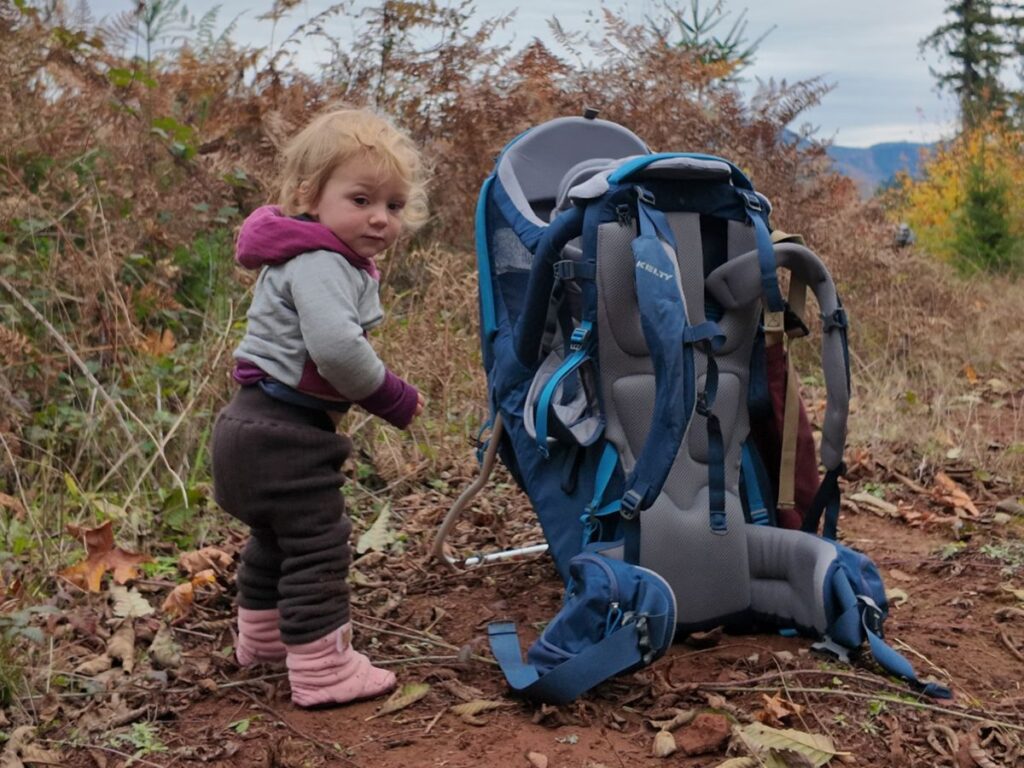
Kelty Child Carrier: My Favorite for Comfortable Heavy Carrying
Kelty has been one of my personal favorites when I’m carrying a lot of weight.
One of the things I really appreciate is the amount of padding. I personally find a well-padded pack extremely comfortable for longer periods, especially as my kids get heavier.
Kelty’s PerfectFIT adjustment system also makes it easier to adjust the torso length, which is useful when caregivers with different body sizes are sharing the same pack.
The child seat is roomy and supportive, and depending on the model, you’ll also find features like sun protection and useful storage.
The frame carries weight well, and overall, I find the design stable and comfortable on the trail.
Of course, all that padding comes with a trade-off. Kelty carriers are one of the heaviest that I’ve used.
The child seat is also more structured than the fabric-style seat on the Thule Sapling. If child positioning is your absolute top priority, I personally prefer the Thule’s seat design.
But when I’m looking specifically at my own comfort while carrying a heavier load, Kelty has been one of my personal favorites.
Best for: Caregivers who prioritize padding and comfort while carrying heavier children.
Which Hiking Child Carrier Is Best?
If I were narrowing these down based on my own experience, I would think about it this way:
- Best child seat and positioning: Thule Sapling
- Best lightweight option: Osprey Poco LT
- Best for air travel: Osprey Poco LT
- Best airflow: Osprey
- Best for long hikes and heavy loads: Deuter Kid Comfort
- My personal favorite for padded heavy carrying: Kelty
There isn’t one winner across every category because these packs solve different problems.
I would rather have the Thule’s child seat design, for example, but I personally find the padding of the Kelty more comfortable for heavy carrying. And if I were flying somewhere and wanted to bring a structured hiking carrier, the way the Osprey Poco LT packs down would be a major advantage.
Your body matters here just as much as the feature list.
Bonus: Trail Magik for Toddlers Who Mostly Want to Walk
The Trail Magik isn’t a structured hiking backpack, so I wouldn’t put it in the same category as the carriers above.
But I absolutely think it deserves a mention.
The Trail Magik attaches to a compatible backpack and gives an older child a supported place to ride on your front. I find it particularly useful once you have a toddler or preschooler who wants to hike independently but inevitably reaches the point where their legs are done.
Instead of carrying a bulky framed child carrier for a child who might walk 90 percent of the hike, you can bring the Trail Magik and pull it out when they need a break.
I’ve also found it really useful when hiking with multiple children.
For example, I can carry a younger child in a structured hiking pack on my back and use the Trail Magik for an older child who needs a temporary ride. If my younger child wants to come to the front for connection, I can sometimes switch things around depending on everyone’s ages, developmental readiness, and the carriers I have with me.
You can also check out my full review of the Trail Magik here.
Can You Carry Two Kids While Hiking?
Yes, but this is where planning becomes especially important.
One setup I’ve used is a structured hiking pack for one child with a Trail Magik available for an older child who primarily walks.
If I’m hiking with a partner, it’s much easier to divide the load. One person can carry the child while the other carries more of the water, food, diapers, and gear. The Trail Magik can also attach to the other adult’s compatible backpack when needed.
If you’re hiking alone and carrying multiple children, you’ll need to pack much more minimally.
You also need to account for the total weight you’re putting into your hiking pack. That includes your child and anything you’re carrying in the storage compartments.
Always check the manufacturer’s total load limit for your specific pack. Even if a setup physically works, exceeding the manufacturer’s stated limits may affect both safety and warranty coverage.
What If My Baby Wants to Be Carried on My Front?
This is one reason I don’t think a structured hiking carrier is automatically the best choice for every hike.
Some babies want the closeness of a front carry, particularly when they’re tired or overwhelmed.
Depending on the child’s developmental stage and the carriers I have with me, I may bring an additional lightweight carrier so I have the option of switching to a front carry.
For younger babies who aren’t developmentally ready for a structured hiking pack, I would choose an appropriately fitted traditional baby carrier instead.
If you’re trying to find an option that works for both everyday life and the trail, my babywearing for beginners page and the best toddler carriers for 2026 can help you explore some of those alternatives.
Final Thoughts: Choosing the Best Hiking Carrier for Your Family
After hiking with four kids and trying multiple structured hiking carriers, I don’t think there’s one pack I would recommend to absolutely everyone.
The Thule Sapling stands out to me for its child seat design. Osprey offers some of the best airflow I’ve experienced, and I particularly like the lightweight, travel-friendly Poco LT. Deuter is worth considering when load transfer and long-distance support are priorities, while Kelty remains one of my personal favorites for comfortably carrying heavier loads.
The most important thing is finding the pack that fits both your child and your body.
And remember, a structured hiking carrier isn’t your only option. Depending on your child’s age and how you hike, a traditional baby carrier or an assisted option may actually make more sense.
If you’re planning more adventures with your kids, check out my guide Let’s Talk Hiking with Littles for everything I’ve learned about getting outside with babies and young children.
And if you’re still deciding which style makes the most sense for your family, I have a full comparison of buckle carriers vs. structured hiking packs and when I personally use each.